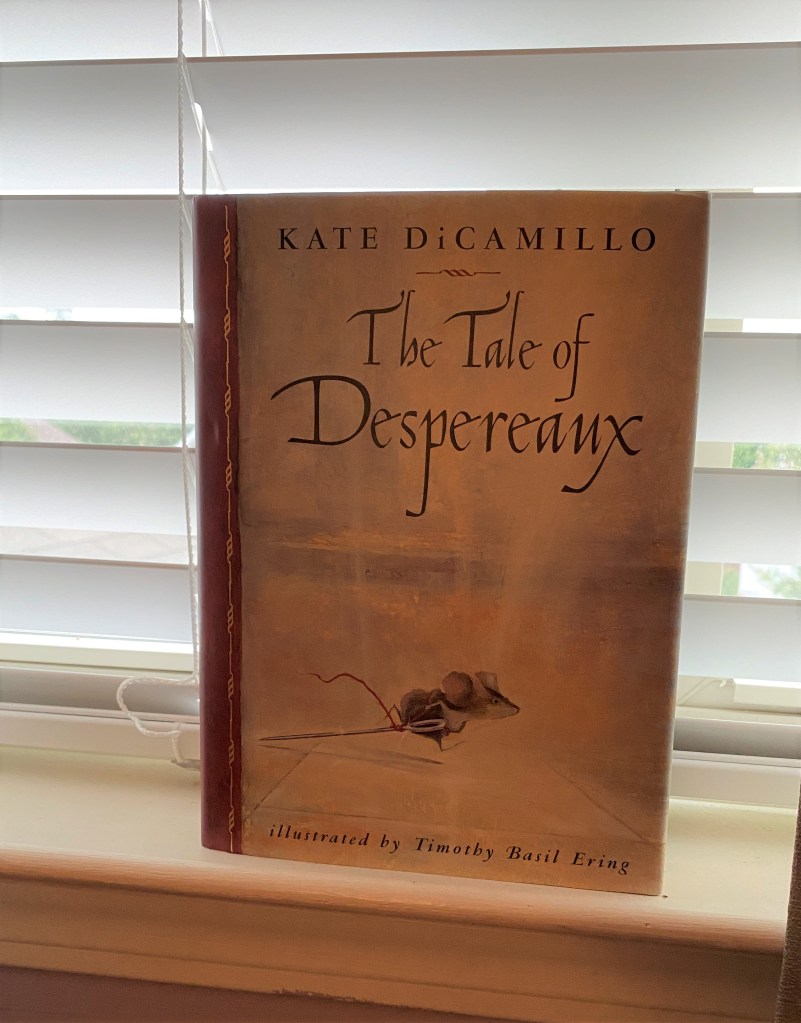
I want to start a new series where I read books from my childhood and see how I feel about them now. This first installment will focus on The Tale of Despereaux by Kate DiCamillo, a book I read in middle school. I don’t remember much about it except I really liked that there were pictures in it.
If you didn’t read this for your middle school summer reading, here is a rundown of the plot. The story takes place in medieval times and all of the main characters live in one castle. The main characters are Despereaux, a mouse; Roscuro, a rat; and Miggery Sow, a servant. The novel is written in second and third person, but each section follows a different character until the last section which weaves all of their stories together.
The story starts with Despereaux, who is disowned by his family for not following the mouse rules of the castle. He interacts with humans, the king and Princess Pea, which is a big no-no in the mouse community. The mouse council orders him to the dungeon to be eaten by rats, which is pretty dark if you think about it.
But soon we are introduced to Roscuro, who wants nothing more than to be in the light of the castle instead of the darkness of the dungeon. We learn that desire led him to make a choice that had some pretty deadly consequences. Now he wants to carry out a revenge plot against Princess Pea, which he tries to do by enlisting the help of servant Miggery Sow.
I really feel sorry for Miggery Sow. Her mother dies. Her father sells her into servitude for “cigarettes, a red tablecloth, and a hen.” The man who buys her gives her “clouts to the ear.” This whole time I did not really know what that meant, but according to Meriam Webster it is hitting someone with a hand. That means this man hit her in the ear so much until she lost some of her hearing.
DiCamillo also describes her as not the sharpest tool in the shed, which is probably why it was so easy for Roscuro to get her to go with his plan. But don’t worry. Despereaux sets out to save Princess Pea from Roscuro’s revenge.
If you got lost in my plot summary, that’s okay. This book does not have a linear plot—something I actually like. The constant jumping back and forth in time through different characters’ points of view kept the story interesting. It all came together at the end in a really satisfying way. Now I definitely see why this book was required reading. There are interesting plot and character devices that you can discuss in the classroom or even just for a book club. Overall, I’m really glad I re-read this one.
 Myah Reads