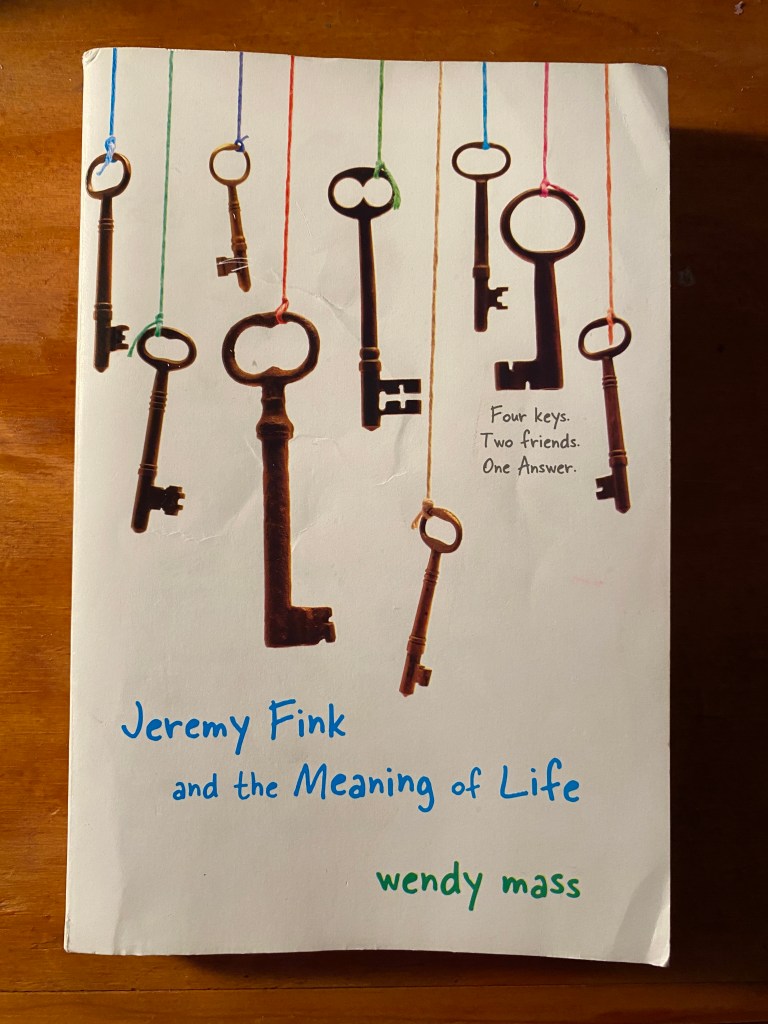
Nostalgia Reads: I Re-Read Jeremy Fink and The Meaning of Life

I’ve decided to continue to my nostalgia reads series with Jeremy Fink and The Meaning of Life by Wendy Mass. This was actually on a different summer reading list than the one I was supposed to be following in middle school, but I read it anyway. Trying to remember this book as an adult was like trying to remember a fever dream. I know I read it, but I wasn’t able to tell you any specific details.

Jeremy Fink and The Meaning Life is about a 12 year old boy living in New York City named Jeremy. A few weeks before his 13th birthday he receives a mysterious box from his late father that is supposed to contain the “meaning of life.” The only problem is he can’t open the box because he doesn’t have the keys. That prompts him and his best friend Lizzy to set out on a quest to find the keys.

I picked up this book because I recently had a pretty bad existential crisis. (Just the usual questions to keep me up at night: Why am I here? What is my purpose? etc.) For a book from a middle school perspective, it dealt with some heavy topics such as death, religion, and the aforementioned existential crisis. I thought it handled them in a way that was honest but still appropriate for that age group.

I really could see this book being a movie because of its cast of fun characters. Jeremy’s best friend Lizzy is so feisty and fearless. His mom is super sweet and I like that she steps up to be a mother figure for Lizzy. Mr. Oswald, a character Jeremy and Lizzy meet after a series of unfortunate events, gives some insightful advice.

Jeremy is a well-written character too. He is rather precocious at times, but Mass does enough to convince you that he is 12 years old. I think there is a lot kids and adults alike can learn from his character development. He is a picky eater and likes to stay in his comfort zone. However, as the story progresses, he learns it is okay to try new things and that going outside of your comfort zone will help you in the long run.

My only critique would be the pacing. I don’t know why but I found the story a bit slow at times. There were chapters where I did not have trouble putting it down. But then I would get to a part that was a little more interesting and keep reading longer. This is not a thriller or page turner. This is an emotional, introspective journey. So if you are looking for something a little sentimental and thought provoking to read, then I would recommend this book.
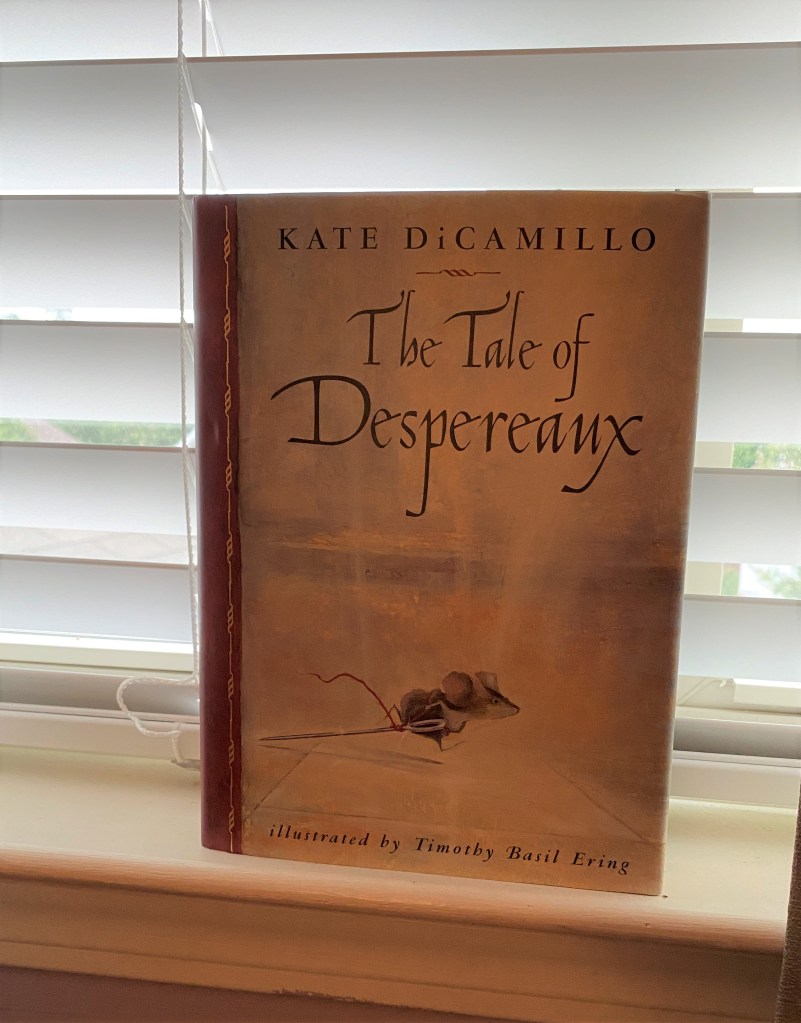
Nostalgia Reads: I Re-Read The Tale of Despereaux

I want to start a new series where I read books from my childhood and see how I feel about them now. This first installment will focus on The Tale of Despereaux by Kate DiCamillo, a book I read in middle school. I don’t remember much about it except I really liked that there were pictures in it.

If you didn’t read this for your middle school summer reading, here is a rundown of the plot. The story takes place in medieval times and all of the main characters live in one castle. The main characters are Despereaux, a mouse; Roscuro, a rat; and Miggery Sow, a servant. The novel is written in second and third person, but each section follows a different character until the last section which weaves all of their stories together.

The story starts with Despereaux, who is disowned by his family for not following the mouse rules of the castle. He interacts with humans, the king and Princess Pea, which is a big no-no in the mouse community. The mouse council orders him to the dungeon to be eaten by rats, which is pretty dark if you think about it.

But soon we are introduced to Roscuro, who wants nothing more than to be in the light of the castle instead of the darkness of the dungeon. We learn that desire led him to make a choice that had some pretty deadly consequences. Now he wants to carry out a revenge plot against Princess Pea, which he tries to do by enlisting the help of servant Miggery Sow.

I really feel sorry for Miggery Sow. Her mother dies. Her father sells her into servitude for “cigarettes, a red tablecloth, and a hen.” The man who buys her gives her “clouts to the ear.” This whole time I did not really know what that meant, but according to Meriam Webster it is hitting someone with a hand. That means this man hit her in the ear so much until she lost some of her hearing.

DiCamillo also describes her as not the sharpest tool in the shed, which is probably why it was so easy for Roscuro to get her to go with his plan. But don’t worry. Despereaux sets out to save Princess Pea from Roscuro’s revenge.  

If you got lost in my plot summary, that’s okay. This book does not have a linear plot—something I actually like. The constant jumping back and forth in time through different characters’ points of view kept the story interesting. It all came together at the end in a really satisfying way. Now I definitely see why this book was required reading. There are interesting plot and character devices that you can discuss in the classroom or even just for a book club. Overall, I’m really glad I re-read this one.  

Infinite Do-overs and Father Daughter Feuds

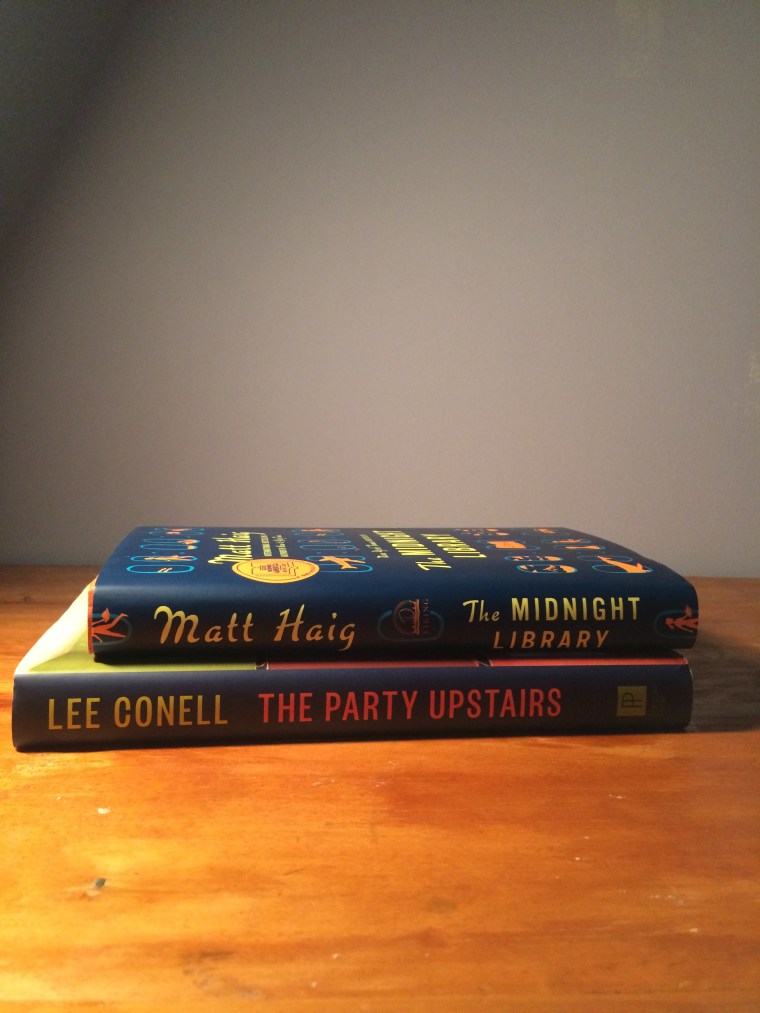
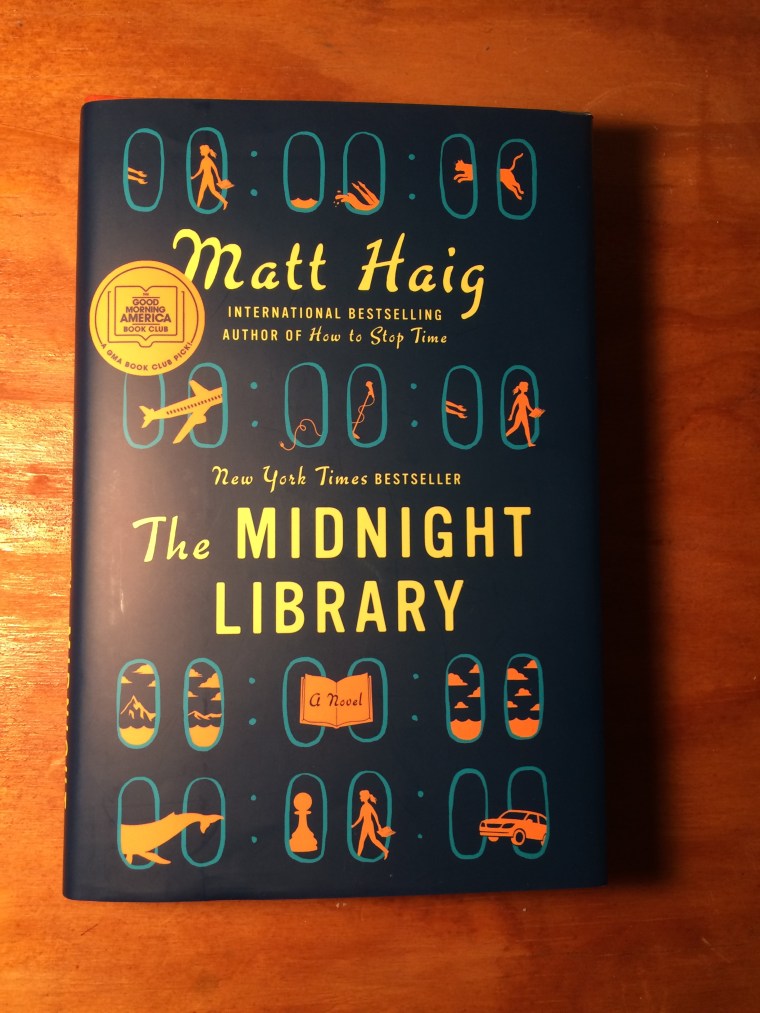
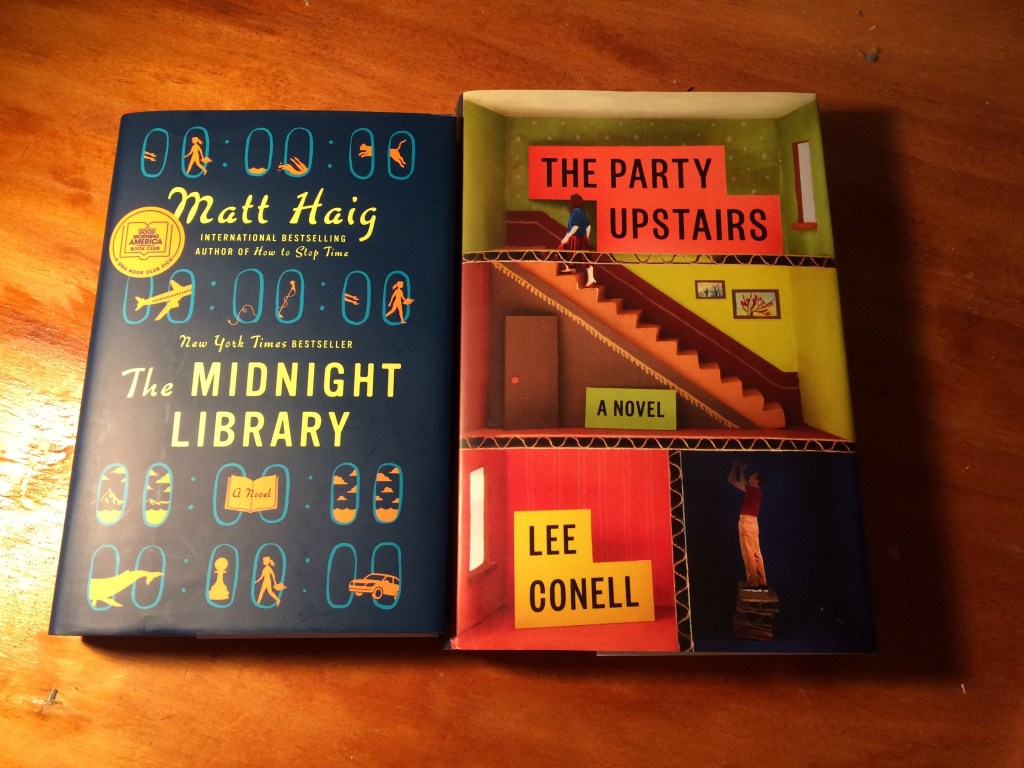
Is it me or did February fly right by? But I did not fly through my reading. I took my time and only read two books, just like January. The first one is The Midnight Library by Matt Haig, which I picked up because I heard it mentioned on a few podcasts and I wanted to see what all of the buzz was about. I would not call this book life-changing, but it was different and it made me think.

The plot is very interesting. It’s about a woman named Nora, who hates her life. That’s not an exaggeration.  She feels like she hasn’t reached her potential and does not think her life is worth living. These feelings lead her to attempt suicide. Instead of dying she ends up in the Midnight Library, which is a sort of limbo. All of the books are different versions of her life based on different choices she could have made. When she picks up the book, she can try out that life.

The story just shows how even minor choices can impact your life in major ways. I found myself reflecting on my own choices that have brought me to the current point in my life. If I decided to do one thing differently (like chose a different college or major), how would my life have turned out? Would I still be in the same place?

That brings me to the major topic in this book: regrets. Nora has a lot of regrets. There’s even a book in the Midnight Library called The Book of Regrets. It’s pretty heavy. As Nora tries out these different lives, her regrets start to disappear. She realizes no matter how cliché it sounds, everything in her life has happened for a reason. That’s something I expected to happen, but it was nice to watch everything unfold. Through this novel I got to see that we don’t need to have all of these regrets and that every day is a chance to start fresh.

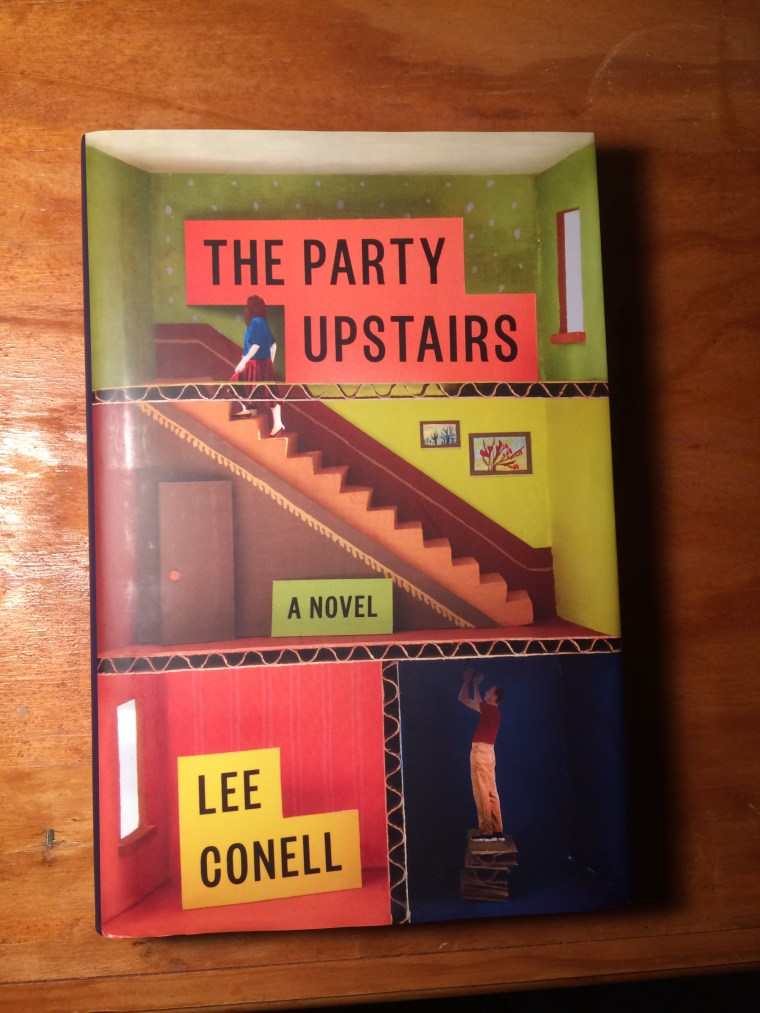
The second book I read in February was The Party Upstairs by Lee Conell. This novel is about a father and daughter, Martin and Ruby, with a tense relationship. Martin is the super for an apartment building in New York City. Ruby is a few years post grad and has moved back in with her parents. She is unemployed and in debt. Martin is extremely disappointed by this and views her as a failure.

The whole story takes place in one day with some flashbacks to flesh it out. It is told from both Martin and Ruby’s viewpoints in alternating chapters. The pace was definitely a slow-burn, but I stayed interested because I wanted to know the breaking point at the end of the story. There was an actual party upstairs and it was a key event in the story.

I don’t think I liked any of the characters, especially Martin. I didn’t necessarily enjoy reading his condescending thoughts toward his daughter. It just felt like he rolled his eyes at every little thing she said and did. There were times where I questioned does he even like her?

Then you have Ruby’s friend, Caroline, the host of the party upstairs. She is staying in her father’s penthouse. She comes from a wealthy family, which is something Ruby is very jealous of. Sometimes you could see how out of touch Caroline was with Ruby’s situation (like helping her get a job interview for an unpaid internship). I just found Caroline a little snobby, even though she wasn’t always aware of it.

Social class is the major theme of the story. It affects Ruby’s relationship with Caroline and her father. But the building and its operations are structured by social class too. All of the wealthy tenants in the building live above Ruby and Martin, because they live in the basement. The story just really made me think about income inequality and how many opportunities in life are tied to money even if we try to ignore it.

Lost Sisters and Best Friends Until The End

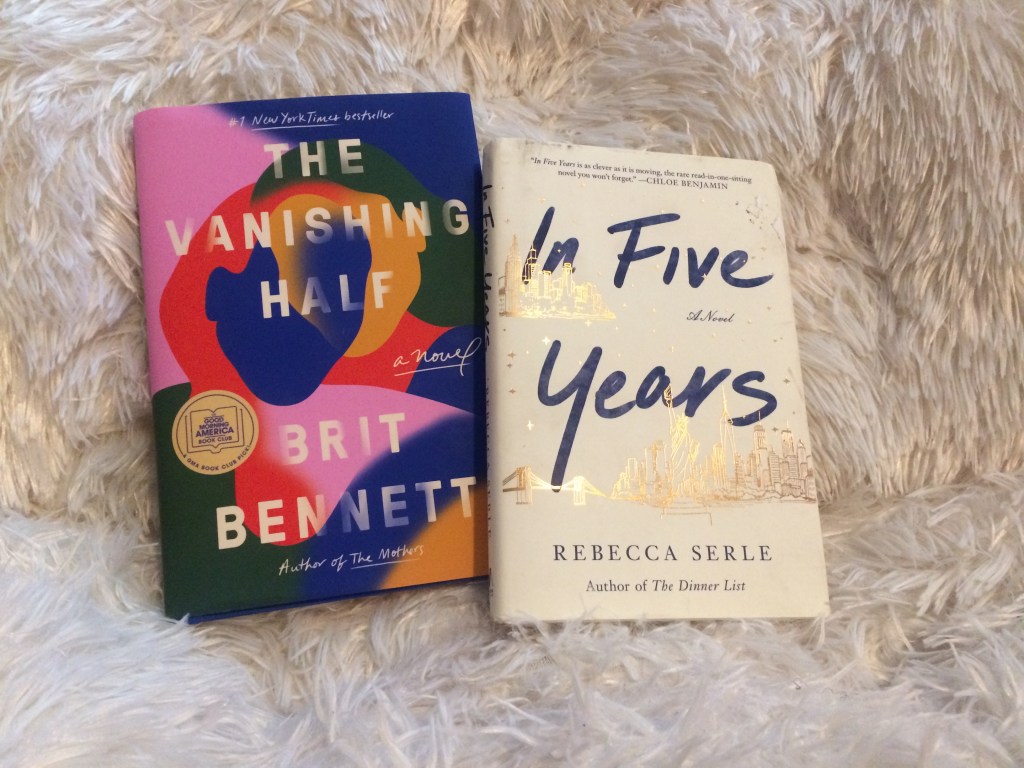
I know February is almost over, but let’s talk about January because that’s when I finally made it to two books that have been on my TBR list for a while. The Vanishing Half by Brit Bennett was probably the most hyped book of 2020. I read Bennett’s first novel, The Mothers, a few years ago and loved it. So I thought this one was worth a try.

The Vanishing Half is about twin sisters, Desiree and Stella, who run away from their small town in Louisiana in 1950’s. They both have very light skin (pretty much like everyone else in their small town), so Stella uses that to her advantage to pass for white to get a job. But she actually continues to live as a white woman and becomes estranged from her family.  Desiree marries a man with much darker skin which their child inherits. She and her daughter end up back in the small town, where her daughter is made to feel like an outsider.

The story follows the lives of the twins and their own daughters throughout the years and when the daughters eventually meet each other. Obviously, this story touches on colorism in a very literal way. But I think reinvention is also the main theme of the story as well. Even though the characters have grown into adults, everyone is still trying to find themselves.

I can’t say if I like this story better than The Mothers, because I feel like these novels are very different from each other. It took a little bit of time for me to really get into it, but the characters were extremely interesting. I loved the chapters that followed Desiree’s daughter, Jude, and the ones that focused on Stella.

Now to the other book I read in January: In Five Years by Rebecca Serle. This was the first book I read by Serle. I will say it ended up going in a very different direction than I expected. In Five Years is about Dannie Kohan, who is type-A and seems like she has her life together. In fact, she actually has a five year plan.

The story starts when Dannie is 28. She is a lawyer who is extremely dedicated to her career. She lives with her boyfriend in New York City. In the first few chapters, she has a pretty good day. She crushes her job interview, has a nice dinner with her boyfriend who proposes and she goes home and falls asleep. She wakes up five years in the future next to someone who is not her fiancé. She spends the present day and the years leading up to that moment trying to avoid it.

I think the description on the book jacket made it sound more like a fantasy than it actually is. I thought there would be magic or time travel in the story. But I think the fact of Danny waking up to her life in five years was actually just a really intuitive dream (sorry for the mild-ish spoiler).

Everything plays out at an even pace. I wouldn’t say this was a page turner necessarily. I could definitely understand some people finding it to be a bit slow or dull in some parts like where she goes into detail about what it’s really like to be a lawyer. But I was curious to see where the story would go and I found the lawyer parts kind of interesting, because I like hearing about other people’s jobs.

A key character in this story is Dannie’s best friend Bella, who is basically her polar opposite. She lives this spontaneous and care-free life. Something happens to Bella that tests Dannie’s friendship with her and brings out a different side of Dannie. I’m not going to say what it is, but it’s definitely a curveball for Dannie. Overall, I don’t think there’s much to complain about with my January reads. I gained some new perspectives and I hope you will too if you take time to read these novels.

A Book Where All of My Literary Wishes Come True

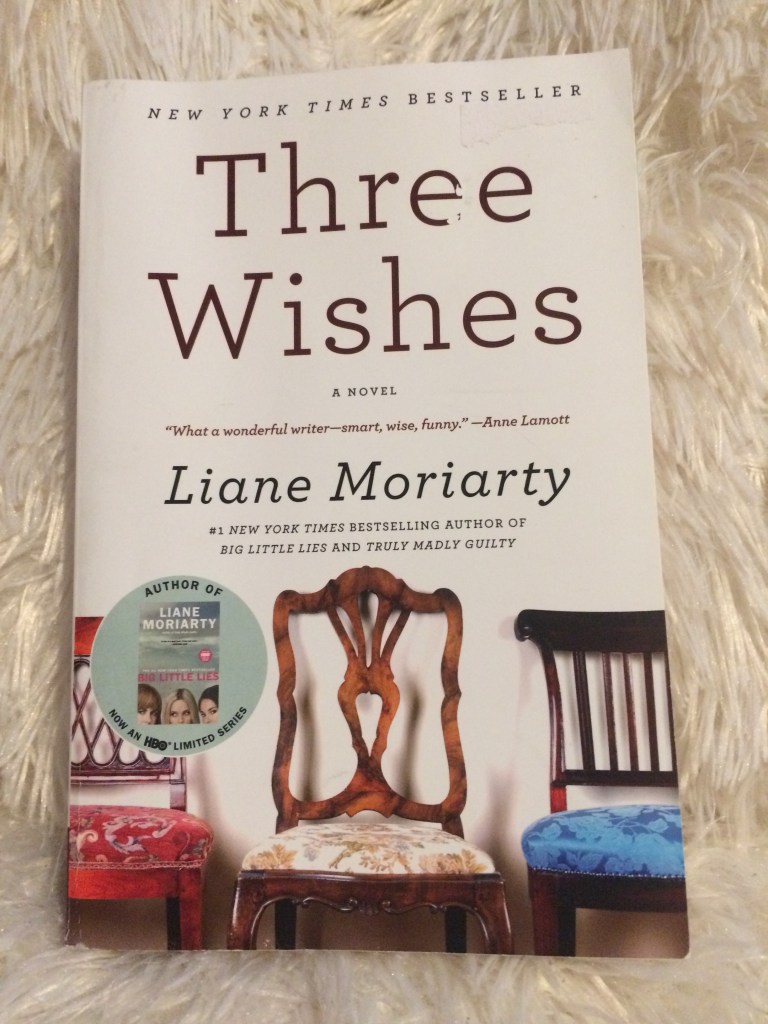
I’ve always wondered what it would be like to be a twin. What is it like to have someone else walking this earth that looks just like you? But to take it one step further, what is it like to live your life with two other people that look just like you? It’s hard for me to imagine life as a triplet, but that’s exactly the focus of Liane Moriarty’s debut novel, Three Wishes, about a set of 33-year-old triplets in Australia. Now that I’ve finished this one, I’ve officially read all of Moriarty’s adult novels. I can say that it has all of the qualities of her novels that I really enjoy.

I think Moriarty is excellent at writing characters. I like the way they talk and think. She usually writes in third person, so you get to hear the inner dialogue of whatever character the chapter focuses on. I think this is especially helpful in telling the triplets: Cat, Lynn, and Gemma Kettle apart.

Specifically, I really like that she gave each triplet a distinct personality that clashes yet still vibes with the other sisters.  Cat is short-tempered and assertive and she is struggling with her marriage, while Lynn is type-A to a fault and is juggling a family and business. Gemma takes a more relaxed approach to life, but she struggles with committing to relationships.

Moriarty also has a creative narrative style. Not only does she use third person, but she also includes these accounts from strangers peppered throughout the novel, where they speak about their chance encounters with the Kettle sisters. In the main chapters, you only hear how the sisters perceive themselves and each other. The strangers’ accounts give you a whole new perspective on the sisters.

Like a lot of Moriarty’s novels, this one revolves around a dramatic event that we’re introduced to in the beginning and then the rest of the novel builds up to it. The novel starts with a major fight between the sisters that ends with one of them throwing a fork at the pregnant sister. It lands in her belly (, but the baby is okay if you were worried).  When I first read about it, it sounded very cartoonish, but it makes more sense toward the end of the novel.

I think Three Wishes plays to one of Moriarty’s greatest strengths, which is tackling darker themes like infidelity, toxic relationships, pregnancy loss, and mental health  while still being able to balance it out with lighter moments. If you want to read this rollercoaster of a novel, I say do it. You only live once. And you might as well get to know what it’s like to do so in a trio.

Sinking My Teeth into Vampires in the Lemon Grove

Karen Russell’s Vampires in the Lemon Grove and Other Stories was a bit of a gamble for me. I don’t normally pick up short stories. But the title caught my attention and I liked that the stories had fantasy elements in them. So I decided to give it a try.

 Let’s start with my personal favorite, Reeling of the Empire. It’s about these young women who work at a silk factory in Japan in what I assume is the early 1900s or sometime during the Industrial Age. But there is a twist that makes this story crazy interesting and gives it potential to be expanded into a novel. The women are transforming into mutant human-silkworms! The factory leader gave them tea with a silkworm in it that started their transformation.  

I really liked the vivid descriptions of the women’s appearances after their transformations and what happened when they made silk. Even though some of those descriptions were a little too vivid (I could feel my stomach turning as I read them). I think the Japanese culture was well-researched and made the story feel real even thought it was about women turning into silk-worms. I thought the rebellion plot picked up the pace of the story and subtly added suspense.

Another story I need to point out is The Graveless Doll of Eric Mutis.  It follows four teenage boys who find a scarecrow in the middle of the woods that looks eerily like their missing classmate they used to bully.  I will admit I found this story really unsettling.

Every time they go see the scarecrow, it is missing a body part. At first, I felt like it was a prank, but then the boys started to get more and more freaked out. I got a little freaked out, because I wanted to know what happened to this kid and how he disappeared, but Russell never gives those answers. However I do appreciate the change in one of the boys as the story progresses. I like that he starts to worry more about what happened to his classmate and to think a little harder about how he treated him. So I see the scarecrow as a lesson on bullying—a very creepy one albeit.

Now let’s finally talk about Vampires in the Lemon Grove, the title and opening story in this collection that gives you a brief look into the life of a vampire couple. I’ve read a lot about vampires in novels and have seen them in movies and television. I understand every writer likes to have their own spin on the genre. In this story, the vampire couple did not drink blood (well at least at the beginning….) and sank their fangs into other objects with lemons being the current one of choice. That was interesting to me, because in most of the vampire stories I’ve encountered, they all had to drink blood at some point. This wasn’t the best story in the collection, but it definitely set the tone for the rest of it.

My least favorite was probably The New Veterans or Dougbert Shackleton’s Rules for Antarctic Tailgating. The New Veterans is about a massage therapist who becomes obsessed with one of her patient’s tattoos and somehow rubs away his traumatic memories from the army. This is an interesting idea, I just found the story really long and I wasn’t very invested in it.

Rules for Antarctic Tailgating was a creative idea, but it didn’t interest me as much as the others. It’s exactly what it sounds like. It lays out the rules for tailgating in the Antarctic. These are for tailgating at the Food Chain Games for Team Whale and Team Krill, even though the rules are specifically for Team Krill. I’m pretty sure Russell is referring to the actual animals for the teams. I just didn’t like this story as much as the others, and I found myself speeding through it trying to get to the next one. I think it was the sportiness of the whole story. I don’t enjoy sports and have never been tailgating. So I don’t think this story was for me.

Overall, Vampires in the Lemon Grove and Other Stories was a very different read. I would deem this collection literary fiction, because I can definitely see English students breaking down these stories in a literature class. I don’t think every story was my taste, but I’m glad I read the book. Now I’m curious enough to check out some of Russell’s other work.

Deep Thoughts & Even Deeper Conversations

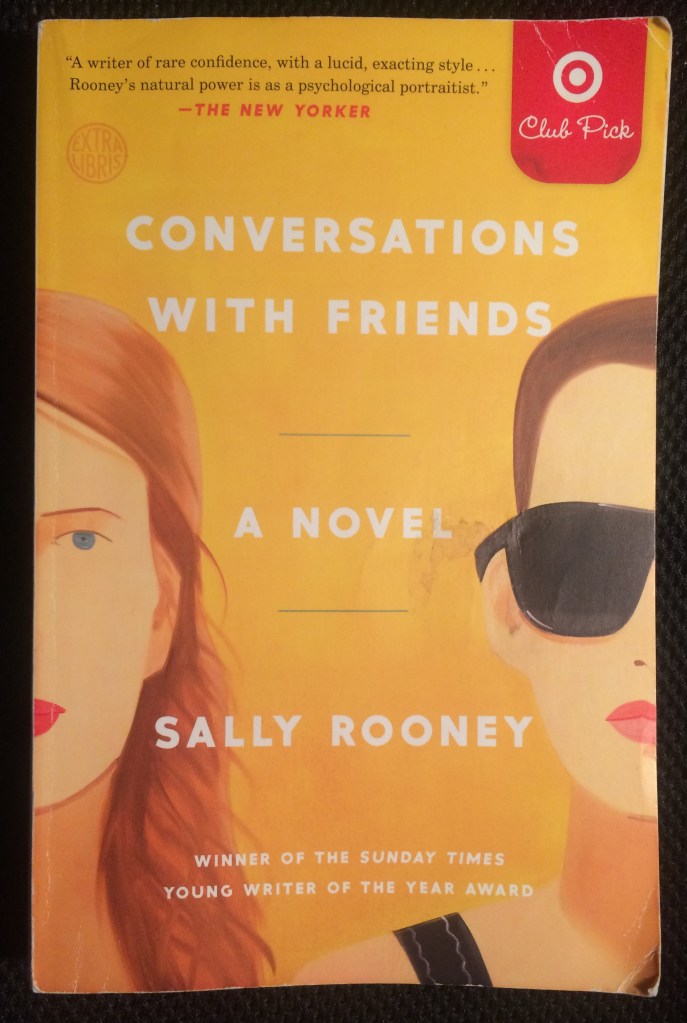
You know that satisfied feeling you get when you finally read a book that’s been on your TBR list forever and actually like it? That’s exactly how I felt when I finished Conversations with Friends. It’s the second novel I’ve read by Sally Rooney and I’m definitely a fan of her work. I enjoy the way she writes her characters and how her stories unfold.

Conversations with Friends is about best friends, Frances and Bobbi, and their budding friendship with a with a well-known photographer, Melissa, and her husband, Nick.  Frances is just your typical bisexual, communist, poetry-writing college student, who happens to be having an affair with Nick. Okay, so not typical—but makes for a great voice. I like the way that Frances thinks—even though it’s radically different from me. I think that’s part of why I loved relaxing and cracking open this book. It felt like an escape from my normal thought process. 

Bobbi is quite the character as well. She has a bossy, out-going personality. She serves as a foil to Frances’ calm and emotionally-detached demeanor. Bobbi and Frances dated in high school but stayed friends after their breakup. They are understandably very close and hang out all the time. One thing they like doing together is performing poetry that Frances writes. It’s at one of their performances that Melissa enters the picture. Then later Nick comes along.

I would describe their marriage as deeply unhappy. I honestly can’t understand why they’re still together, because they clearly don’t enjoy each other’s company. But then that brings us to the affair which is written in such a weird ambiguous way, because it feels like the characters cared about the affair but they didn’t care at the same time. Yes, Frances and Nick were guilty and secretive about it. But it kept on going.

In an interview I read in the back of the novel, Rooney says she didn’t think the characters “were any worse than protagonists in other novels” and she viewed them as foolish instead of evil. That was interesting to me, because so often people try to label fictional characters as a good guy or bad guy, when sometimes they just exist in a weird gray area.

Overall, I thought that book was thought-provoking and fascinating. It makes me look forward to the next novel Rooney writes whenever that happens. If you don’t mind a little moral ambiguity, lack of quotation marks, and enjoy witty banter, then you might need to add this novel to your own TBR list.

Taking a Little Trip to the Supermarket

I think Supermarket is one of those books where it is obvious that it was written by a particular person. Bobby Hall (a.k.a. Logic) wrote the book and it comes off as something that Logic would write. I don’t know why I get this feeling. I think the music references and the voice give it away.  It feels like this rapper would write a book with references to alternative music and a character that thinks so openly about his creativity, all in such a conversational style.

Now let’s get to what this book is actually about: a 24 year old named Flynn, who works in a supermarket. But he is also a writer working on a book he is determined to finish. You see Flynn and I suffer from the same problem. You have all of these ideas in your head, but when you try to execute them, you have trouble following through.  Growing up I would start writing these stories, but never finish them. It’s like I would feel really inspired but lose steam. However, Flynn refused to lose steam on this project. He really commits to the book, by working in its setting, a supermarket.

I genuinely like Flynn as a character. He has such an interesting viewpoint. I really liked how Hall wrote him as an unreliable narrator, and I liked the stream of consciousness style he used sometimes. For example, when Flynn was narrating, he would go on these random tangents and then all of a sudden say something along the lines of “wait, what was I talking about?” Or he would start describing something that’s a little unbelievable that would make me wonder, did that really happen? But he would quickly say later “no I’m just kidding.”

The other characters were okay. Frank, another guy who works at the supermarket, was definitely obnoxious. But once you read the book, you understand why he is that way. Let’s just say Flynn has a little bit of Frank in him. I also loved his relationship with Maria, the girl who worked in the bakery that he started dating. They complemented each other really well.

There were a few plot twists—but I saw them coming. I think that’s because I skimmed the chapter titles in the table of contents and I saw one of them was called “Asylum,” and I just pieced it together as the story went along. I think Supermarket is a pretty quick and fun read. If you don’t want to slog through anything too difficult and enjoy books about a writer’s dedication to his craft—then go for it.

The Bittersweet Nature of Sweetbitter

Stephanie Danler’s Sweetbitter has been on my TBR list for a while now. I saw it on one of those books to read in your twenties lists online. I’m definitely interested in books with characters navigating their twenties, because I’m trying to do the same for myself. I also liked that the main character, Tess, worked at a restaurant because I have also worked at restaurants. So I assumed I would enjoy the book because I thought I would be able to relate to the main character.

But Sweetbitter ended up being a lot different than what I expected.  I’m still on the fence as to whether or not I liked it. I definitely didn’t hate it, but I don’t know if I loved it either. For now, let’s just call it a pleasant read.

The novel follows 22-year-old Tess and her journey working at an upscale restaurant in New York City. I really enjoyed learning about how the restaurant works.  I’ve only worked at fast food restaurants, so I don’t really know much about what goes behind the scenes at these fancier establishments. I noticed the positions are a lot more specific. This restaurant has backwaiters, servers, and senior servers. These are roles that probably would have been combined at a more casual place. Don’t even get me started on the wine descriptions. I felt so uncultured reading them. They just went right over my head, because my knowledge of alcohol is almost non-existent.

I still don’t know what to make of Tess. She is the narrator, but for some reason she feels very detached. I don’t know much about her and I think that has to do with the lack of back story. I know she didn’t have a good relationship with her family. Her mother left and her dad wasn’t really there emotionally for her. But that’s about it. She says she came to New York to escape but she doesn’t know what from? I think she was just lonely.

I think it’s this loneliness that causes her to get so absorbed in work and hang out with her coworkers frequently, even though some of them could be very cold to her. At least in the beginning. Most of them came around the longer she worked at the restaurant.  But I also need to say I really did not like Jake or his relationship with Tess.  Jake is a bartender who Tess had a huge crush on and she later started sleeping with him. I just felt like he talked down to her too much.

But her time with Jake, like the work mistakes, the drugs, and the heavy drinking are all a part of her journey. I think she started to grow after going through all of these negative experiences, which I could see more toward the end of the book.  However, I need to say this book ended in a weird way and I don’t know what I was supposed to get out of it. It was so open-ended that I can’t even guess what would happen next.

This book wasn’t a major page-turner for me, but it definitely wasn’t the slowest book I’ve ever read. I think it was a nice medium pace if that makes sense. I think this novel is for people who like books that really focus on the characters and their growth and are foodies and/or wine enthusiasts.

Nothing is Forever in Permanent Record

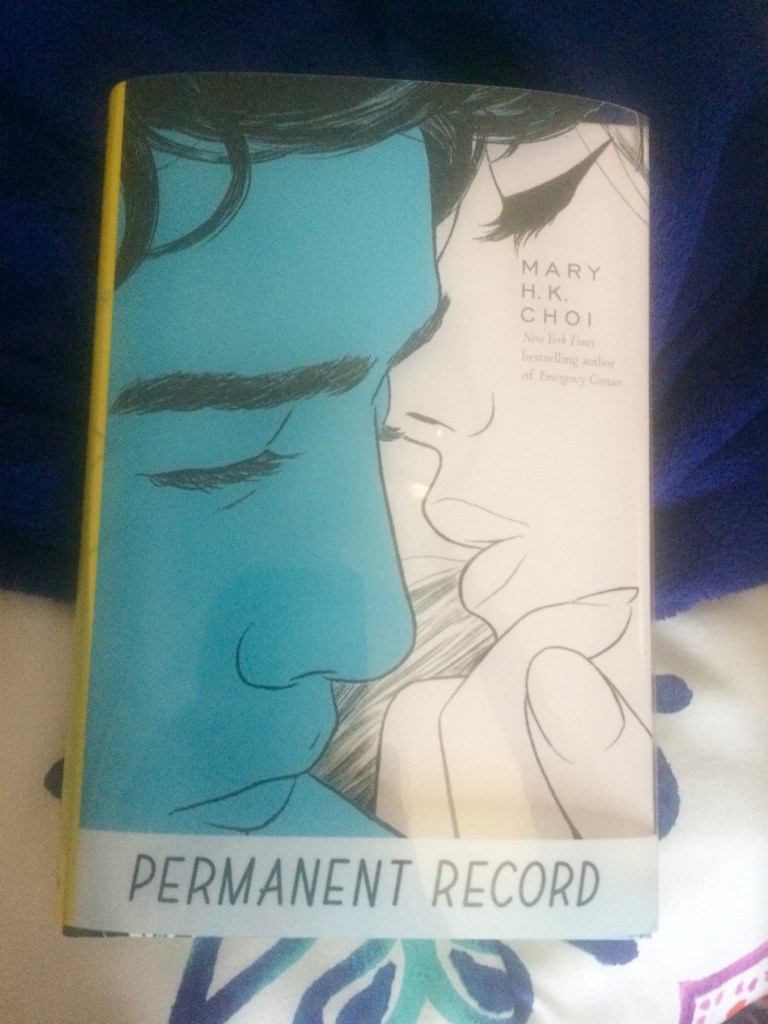
I bought Mary H.K. Choi’s Permanent Record on a whim from the Books-A-Million website with an e-gift card. It sounded cute enough.  Boy meets girl in a grocery store. Girl turns out to be a pop star. She sweeps him off his feet and they have a whirlwind romance. But this definitely isn’t a Cinderella story. Let me explain.

This novel follows Pablo, a nineteen year old college dropout working in a health food store in New York. He doesn’t really know what he wants in life. He’s idling by while also stressing out about his massive amounts of debt. But then Leanna enters the picture.

She is basically the fictional version of all those child stars from Disney Channel and Nickelodeon who are still musicians and actors as adults. She’s trying to make that transition. But she seems pretty exhausted with her fame which is probably why she views Pablo as breath of fresh air.

However this novel is more about Pablo than Leanna. I will admit when I first started reading Permanent Record, I wanted it to alternate between Pablo and Leanna’s viewpoints like Choi’s first novel , Emergency Contact. But I came to appreciate Pablo as the sole narrator. I thought his voice could be a little cheesy, because he used “drip” and other slang throughout. But I accepted it because it adds to the character.

He definitely was not a perfect character, which really showed when he became so dependent on Leanna. Not so much financially but emotionally. He would practically disappear and not tell anyone while he jetted off to some faraway land with Leanna. I thought it was weird when she asked him to go to these places knowing he had a job and thinking he went to school (something Pablo lied to her about).

But I did like that this book took a very close look at money and how it controls our lives, especially when you’re in debt. Pablo is legally an adult, but when you’re nineteen, you sometimes still have the mindset of a kid, which Pablo does acknowledge. I think that’s how you see him grow up is when he decides to tackle his debt instead of running away from it.

Overall, Permanent Record is a nice summer read, but I might not remember it in two months. While this book did not make a lasting impact on me, it did take me on a bit of mental vacation, with a healthy dose of reality (the whole debt thing was slightly stressful because I have debt myself).  If you just want something to get through really quickly and not think too much, then you may want to give this book a shot.